Vercel vs AWS Amplify: Brutally Honest Comparison 2026
If you search Google for the "best hosting for modern JavaScript frameworks" or an "AWS alternative," the results you get are almost universally terrible. The internet is currently flooded with generic listicles written by SEO marketing agencies. These writers have never deployed a server, authenticated a JWT, or dealt with a CORS error. They write reviews designed entirely to capture affiliate commissions. They will tell you a platform is "highly scalable" without ever testing the actual database read/write latency. They will call an API "developer-friendly" just because the website has a dark mode toggle.
At DevDecide, we believe that honest developer tool comparisons require actual engineering work. A real technical review means spinning up a production-mimicking sandbox. It means writing the code to integrate the SDK, intentionally breaking the implementation to see if the error handling is human-readable, and cross-referencing our findings with complaints from real engineers on Hacker News and Reddit. We expose the truth behind the marketing copy using our strict technical testing methodology.
When you search for a Vercel vs AWS Amplify review, you deserve the brutal truth about connection pooling, vendor lock-in, and raw CDN latency across the entire JavaScript ecosystem.
Whether you are building with React, Vue, SvelteKit, Remix, or a lightning-fast Vite SPA, you eventually have to decide where your code will live. For years, the default answer was Vercel. But as traffic scales, devastating bandwidth bills have sparked a massive developer migration toward AWS. Amazon responded with AWS Amplify Gen 2, promising full-stack simplicity.
So, do you pay the premium for Vercel's zero-config magic, or do you brave the AWS console to protect your runway? Here is the definitive technical comparison.
How We Tested Vercel vs AWS Amplify
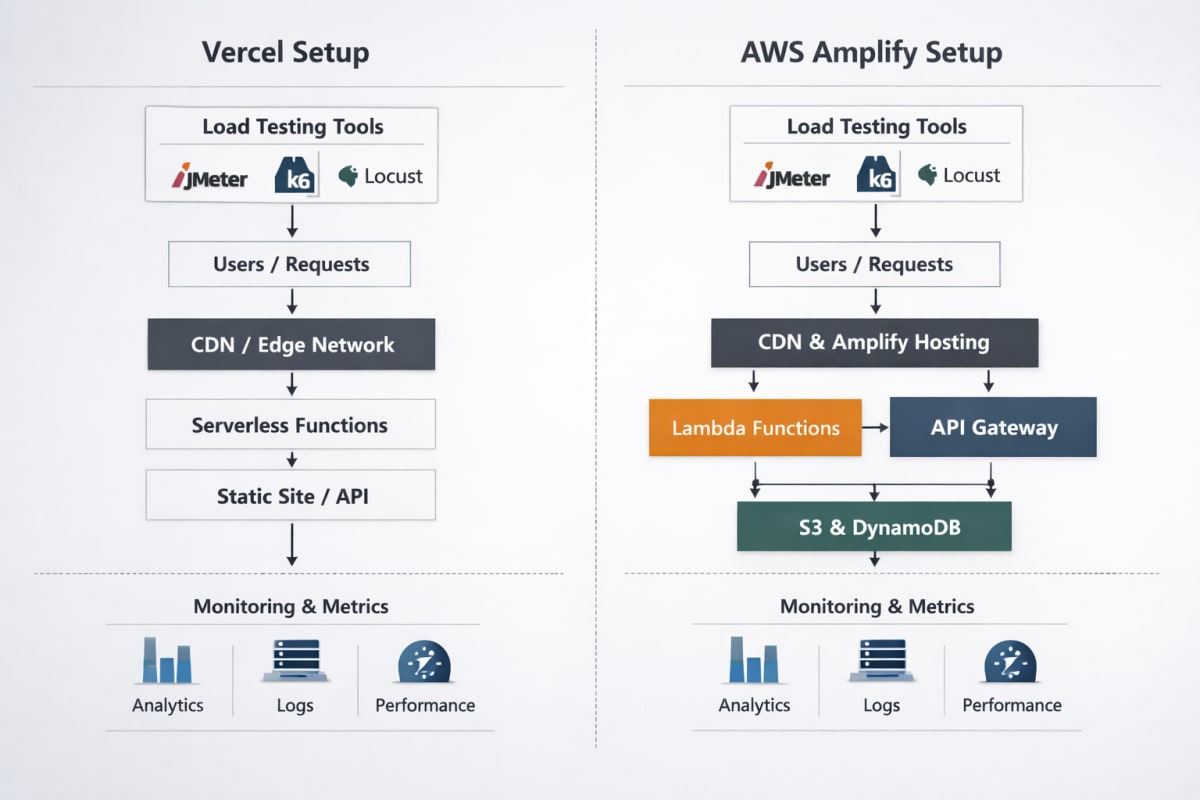
To get beyond the marketing hype, we completely ignored the documentation and went straight to the code. We built three identical, data-heavy applications using Nuxt 3, SvelteKit, and a standard React SPA powered by Vite. We then deployed these repositories to both Vercel (Pro Tier) and AWS Amplify Gen 2 to see how they handled actual stress.
We ran intense load tests using Artillery, simulating 2,500 concurrent users performing aggressive read/write operations and downloading heavy unoptimized image assets. We intentionally sent malformed data payloads to trigger server-side validation errors, monitored the deployment pipeline build times, and checked the real-world latency of their respective Edge networks.
The Architectural Divide: Vercel vs AWS Amplify
Before we look at a single line of code, we have to understand the underlying architectural differences. They fundamentally treat your application in completely incompatible ways.
Vercel is an Edge Performance Platform. Vercel is not trying to be a database provider, a message queue, or an identity manager. They are laser-focused on taking your JavaScript framework and serving it to your users as fast as physically possible. Under the hood, Vercel actually runs on top of a heavily optimized blend of AWS and Cloudflare. They abstract away all the complex cloud primitives—like S3 buckets, CloudFront distributions, and API Gateways—and replace them with a beautiful, unified Edge network. You don't configure servers; you just push code.
AWS Amplify is a Full-Stack Cloud Platform. Amplify is Amazon's answer to Firebase. When you deploy a JavaScript application to Amplify, AWS is quietly provisioning underlying infrastructure on your behalf. More importantly, Amplify is designed to deeply integrate your frontend with backend AWS services like DynamoDB for NoSQL storage, AppSync for GraphQL APIs, and Cognito for user authentication. It is essentially infrastructure-as-code (IaC) hidden behind a command-line interface.
The Developer Experience (DX) and CI/CD
Deployment speed dictates your engineering team's velocity. How fast can you ship a critical bug fix to production? When comparing the developer experience of Vercel vs AWS Amplify, the gap is immediately noticeable.
The Vercel Experience
Vercel’s developer experience is the gold standard of the industry. You connect your Git repository, and you are done. There are no build scripts to configure, no Dockerfiles to write, and no complex IAM (Identity and Access Management) roles to assign.
Vercel’s most powerful feature across any framework is its Preview Deployments. Every time a developer opens a Pull Request, Vercel automatically generates a unique, live URL for that specific branch. Your QA team, designers, and stakeholders can test the exact feature in a production-like environment before it ever merges to the main branch. When you do merge, Vercel's build caching is aggressively optimized. Massive enterprise Nuxt or Svelte applications often deploy in under 90 seconds.
The AWS Amplify Experience
With the release of Amplify Gen 2, AWS has drastically closed the DX gap. You can now connect a GitHub repository to Amplify and get automated CI/CD pipelines and Preview Deployments out of the box for most major frameworks.
However, because Amplify is fundamentally an AWS service, it is inherently more complex. If you are using a monorepo structure (like Turborepo or Nx), or if you need a specific Node.js version that isn't in their default Amazon Linux build image, you will find yourself digging through YAML build specifications (amplify.yml) to force the pipeline to behave. Build times on Amplify are also noticeably slower, often taking 3 to 5 minutes for a mid-sized SSR application, compared to Vercel's sub-minute builds.
Framework Support: Vercel vs AWS Amplify
The modern JavaScript ecosystem is incredibly diverse. How well do these platforms handle frameworks outside of Next.js?
Vercel: The Universal JavaScript Host
While Vercel is famous for creating Next.js, their support for the broader ecosystem is unmatched. Rich Harris, the creator of Svelte, works at Vercel. Consequently, SvelteKit is treated as a first-class citizen, with Edge routing and server-side rendering working flawlessly on Day 1.
Similarly, frameworks like Nuxt (Vue) and Remix have dedicated build adapters maintained directly by Vercel. If your framework compiles to standard JavaScript, Vercel’s infrastructure will automatically detect it, optimize the output, and distribute your static assets globally while perfectly routing your server-side API calls.
AWS Amplify: A Mixed Bag for SSR
Amplify is phenomenal for traditional Single Page Applications (SPAs) built with Vite, React, or Vue. Because SPAs are just static HTML, CSS, and JS files, Amplify drops them perfectly into an S3 bucket and serves them via CloudFront. It is bulletproof.
However, Server-Side Rendering (SSR) is where Amplify has historically struggled. Running Nuxt 3 or SvelteKit on AWS often meant relying on AWS Lambda@Edge, which is notoriously slow to deploy and difficult to debug. While Amplify Gen 2 has introduced native support for many SSR frameworks, advanced rendering techniques like Incremental Static Regeneration (ISR) and granular Cache-Control headers are still much harder to fine-tune on Amplify than on Vercel's purpose-built Edge Network.
The Pricing Reality: The Bandwidth Tax
This is the primary reason developers jump ship. The debate over Vercel vs AWS Amplify pricing has dominated developer forums for years, but the math is brutal and unforgiving.
The Vercel Pricing Trap
Vercel's Hobby tier is incredibly generous, but commercial projects must immediately upgrade to the Pro Tier ($20/month per developer).
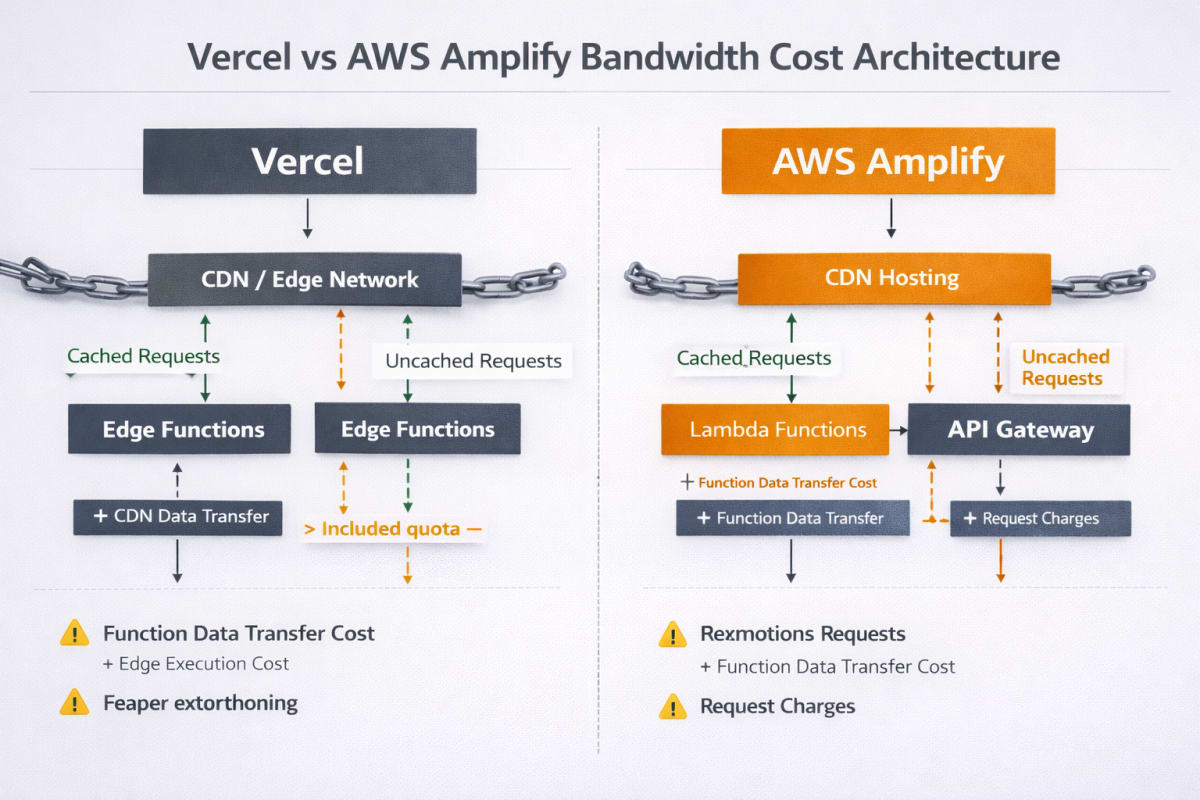
The biggest trap when evaluating Vercel vs AWS Amplify pricing is Vercel's consumption metrics. On the Pro tier, Vercel gives you 1TB of outbound bandwidth. If your startup goes viral, or if you are serving heavy, unoptimized user-uploaded media, you are charged a staggering $40 per 100GB of overage. This markup is astronomically higher than raw AWS bandwidth costs. Additionally, Vercel charges for Serverless Function execution and Edge Requests. If you have a highly dynamic application with millions of API calls, your $20/month Pro plan can easily balloon into a $1,000/month bill overnight.
It is a trap for the unprepared.
The AWS Amplify Reality
Amplify uses a pure consumption-based, pay-as-you-go model. There are no arbitrary per-developer seat licenses to worry about.
- Data Transfer Out: ~$0.15 per GB
- Build Time: $0.01 per minute
- Storage: $0.023 per GB
For high-traffic, bandwidth-heavy applications, AWS Amplify will be significantly cheaper than Vercel at scale. A viral traffic spike that costs $500 on Vercel might only cost $40 on AWS.
However, you must factor in engineering time. If your team spends 15 hours a month debugging AWS IAM permissions, configuring Route 53 DNS records, and fighting CloudFront cache invalidations because you miss Vercel's automated workflow, that AWS "cost savings" is entirely wiped out by the sheer cost of developer salaries.
The Final Verdict: Vercel vs AWS Amplify
Choosing between Vercel vs AWS Amplify ultimately comes down to a single question: what does your company value more, Engineering Velocity or Infrastructure Control? There is no one-size-fits-all answer for the JavaScript ecosystem.
Choose Vercel if: You are a fast-moving startup, an agency, or a lean team building a standard SaaS product with SvelteKit, Nuxt, Remix, or React. The premium you pay for Vercel's bandwidth is essentially the salary of a DevOps engineer you didn't have to hire. The ability to deploy instantly, use Preview URLs for stakeholder sign-off, and know that your framework will just work without writing YAML files makes Vercel the undisputed king of frontend developer experience.
Choose AWS Amplify if: You are already deeply entrenched in the AWS ecosystem. If your Nuxt or React application requires strict HIPAA compliance, integrates heavily with Amazon Cognito for enterprise identity management, or uses AppSync for real-time GraphQL subscriptions, Amplify Gen 2 is the clear winner. Furthermore, if you are building an incredibly high-traffic, media-heavy application where raw bandwidth costs are your primary concern, Amplify allows you to bypass Vercel's extreme markups and scale sustainably on Amazon's global infrastructure.